
What products are involved?
Rheonics SME – Sensor Module Electronics
What is the purpose of this article?
The article describes the integration of the Rheonics Sensor Module Electronics (SME) with an Isolated Signal Splitter for the device’s analog outputs.
TABLE OF CONTENTS
1. Overview
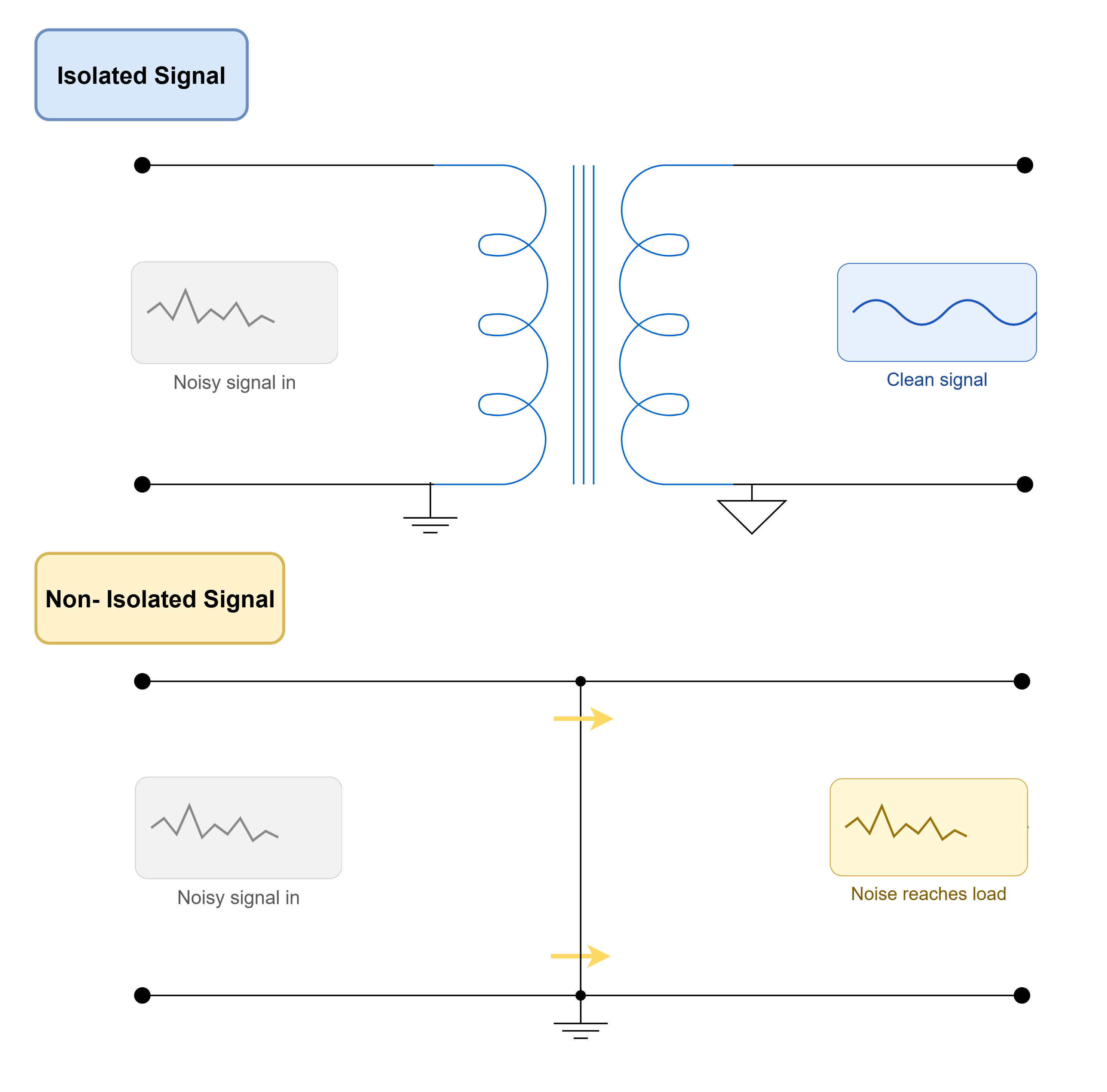
Signal splitters are active industrial interface devices designed to duplicate a single analog measurement signal, typically 4–20 mA, into two or more independent outputs while maintaining galvanic isolation between the input, outputs, and power supply. Their primary purpose is to preserve the integrity of the original measurement and allow multiple systems, such as PLCs, DCSs, HMIs, recorders, data loggers, or secondary controllers, to simultaneously receive the same process value without introducing loading effects or signal disturbances.
Isolation is a key feature because it minimizes electrical noise, ground loops, and interference that can occur when interconnected devices have different grounding or power arrangements. The signal splitters provide a reliable alternative to passive signal branching, which can cause measurement errors and grounding problems. Therefore, connecting them to the self-powered analog outputs of the Rheonics SME can be very useful for the user.
2. Signal Splitters Integration with Rheonics SME
2.1 Rheonics SME 4-20mA outputs
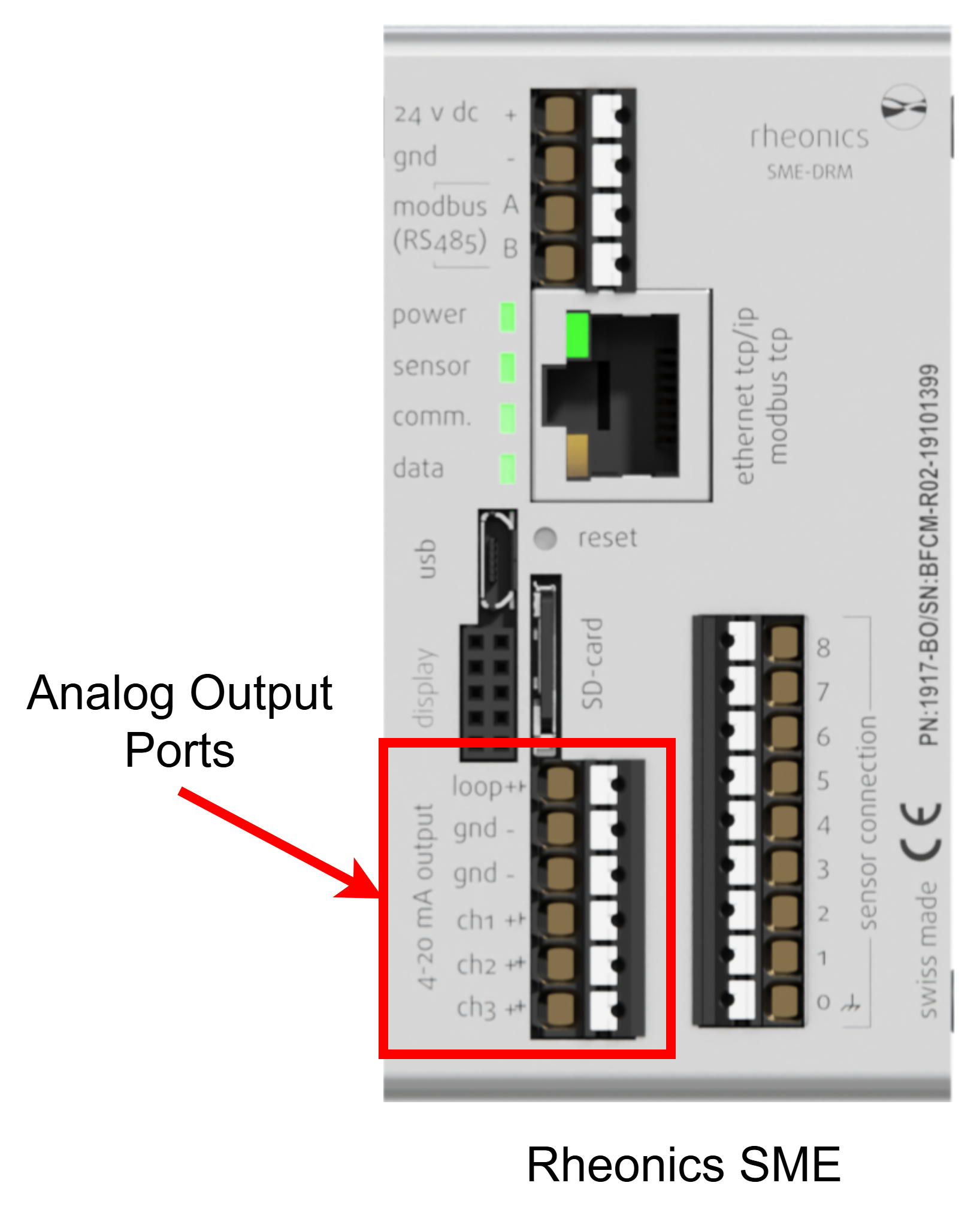
The Rheonics SME has three analog output channels, one for each parameter. The default settings are shown in the tables below, but they can be edited in the Rheonics Control Panel according to the instructions in the Analog signals setup with the RCP support article. For more information related to the analog outputs, review our Support Articles on the topic.
| Channel Number | Parameter |
|---|---|
| 1 | Viscosity |
| 2 | Density |
| 3 | Temperature |
Table 1. Analog outputs default parameters for the Rheonics SRV sensor
| Channel Number | Parameter |
|---|---|
| 1 | Density |
| 2 | Viscosity |
| 3 | Temperature |
Table 2. Analog outputs default parameters for the Rheonics SRD sensor
The module is considered a 4-wire transmitter, which means that it is an active sensor device. For more information, see the Connecting 4-20 mA outputs support article.
2.2 Connection with Rheonics SME
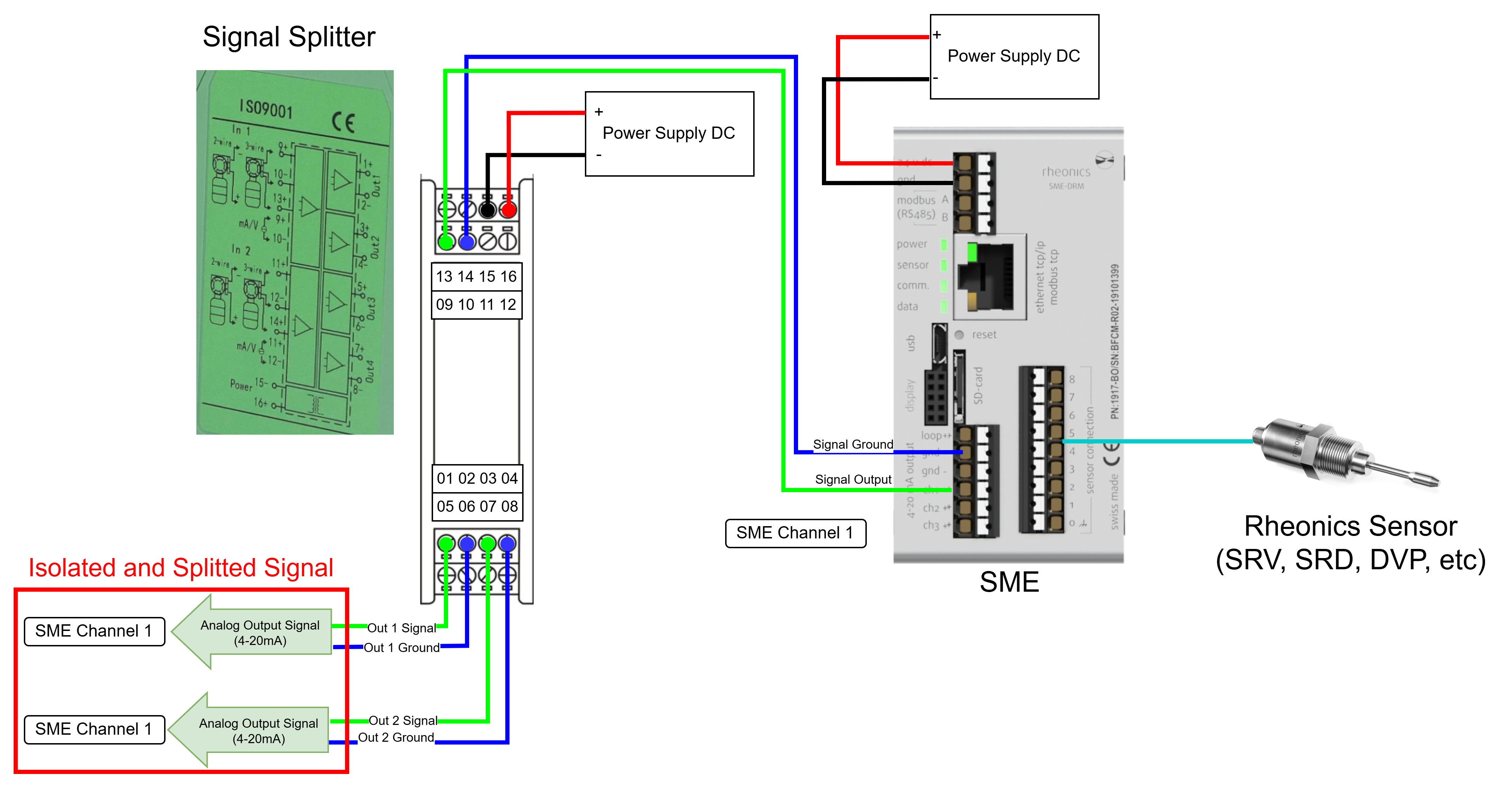
For integration with the Rheonics SME, it is important to define the specifications or requirements of the application. The signal splitter selected should have its own independent power supply and be capable of handling mA signals as both inputs and outputs. A reference connection diagram is shown below (Figure 3). An additional feature to consider is the number of signals supported by the splitter. There exist versions exist with 2 inputs and 4 outputs, as well as versions with 1 input and 2 outputs.
3. Commercial Alternatives
3.1 Kuuleyn Signal Splitter and Isolator
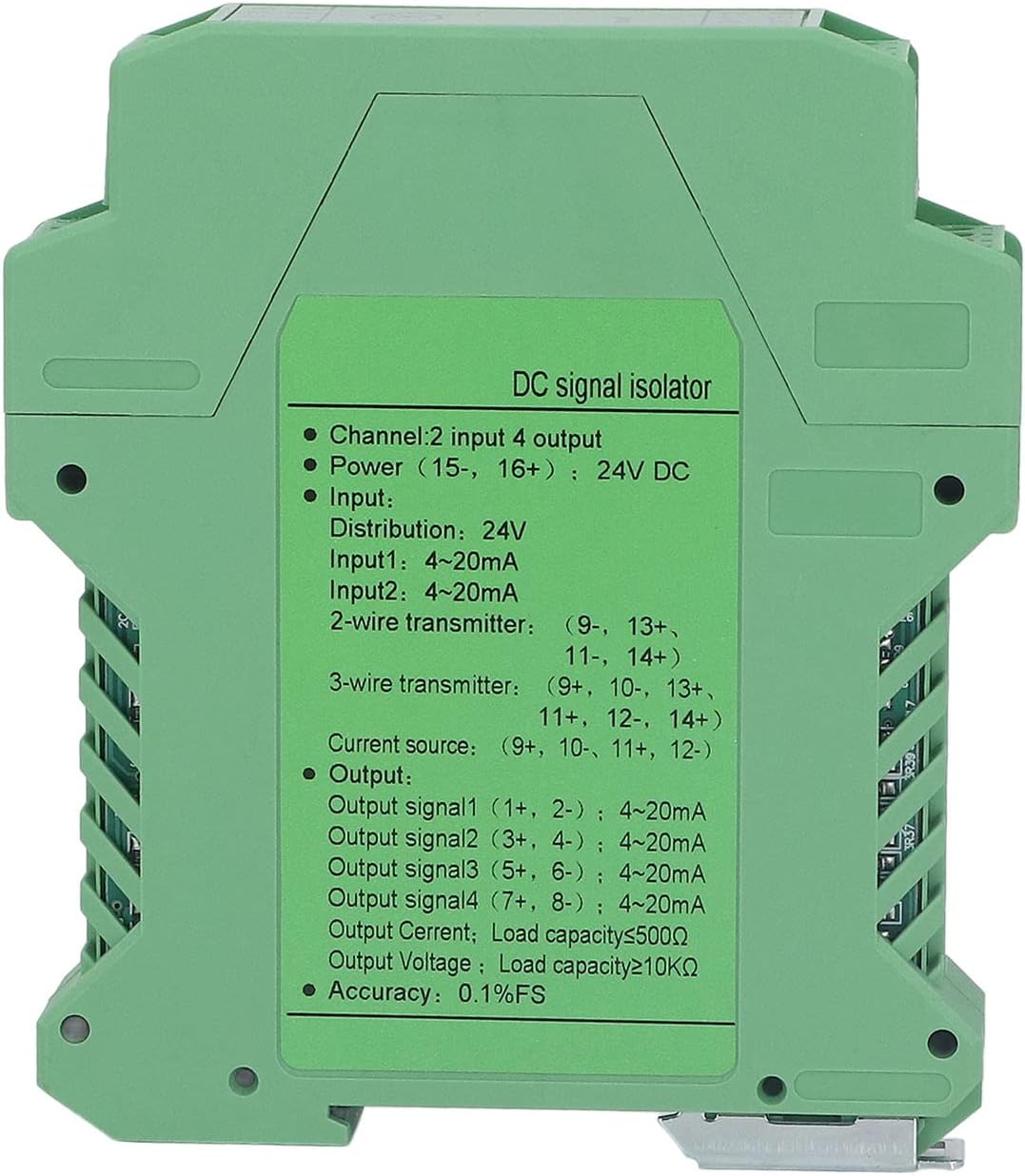
This 4–20 mA signal splitter/isolator is an industrial signal-conditioning module designed to accept two 4–20 mA analog inputs and provide four isolated current outputs, allowing a single process signal to be distributed to multiple PLCs, controllers, monitoring systems, or data acquisition devices without signal degradation. Operating from a 24 VDC supply, it uses galvanic and photoelectric isolation to electrically separate inputs and outputs, helping prevent ground loops, electrical noise, and interference.
3.2 Levtech Isolated Splitter for Analog Signals
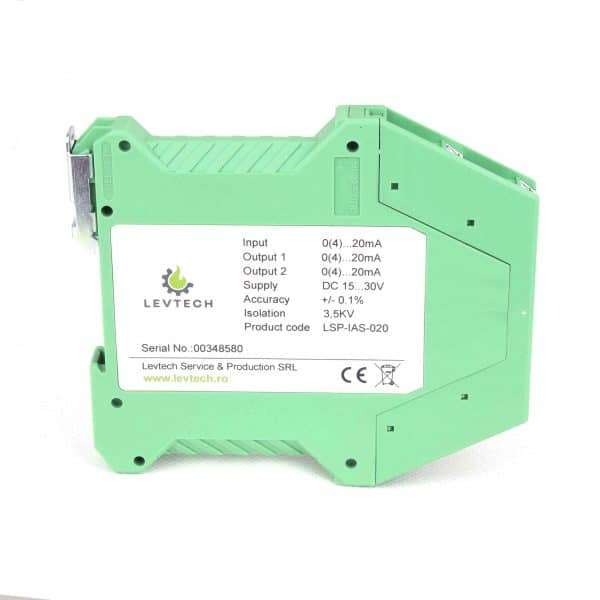
The Levtech LSP-IAS Isolated Splitter for Analog Signals is an industrial DIN-rail-mounted signal splitter designed to duplicate a single analog input signal into two identical, electrically isolated outputs. It is available for standard process signals such as 4–20 mA, 0–10 V, and 0–5 V. The unit provides four-way galvanic isolation between the input, both outputs, and the power supply, helping to eliminate ground loops, reduce electrical interference, and improve system reliability.
3.3 Datexel DAT4530 Signal Splitter
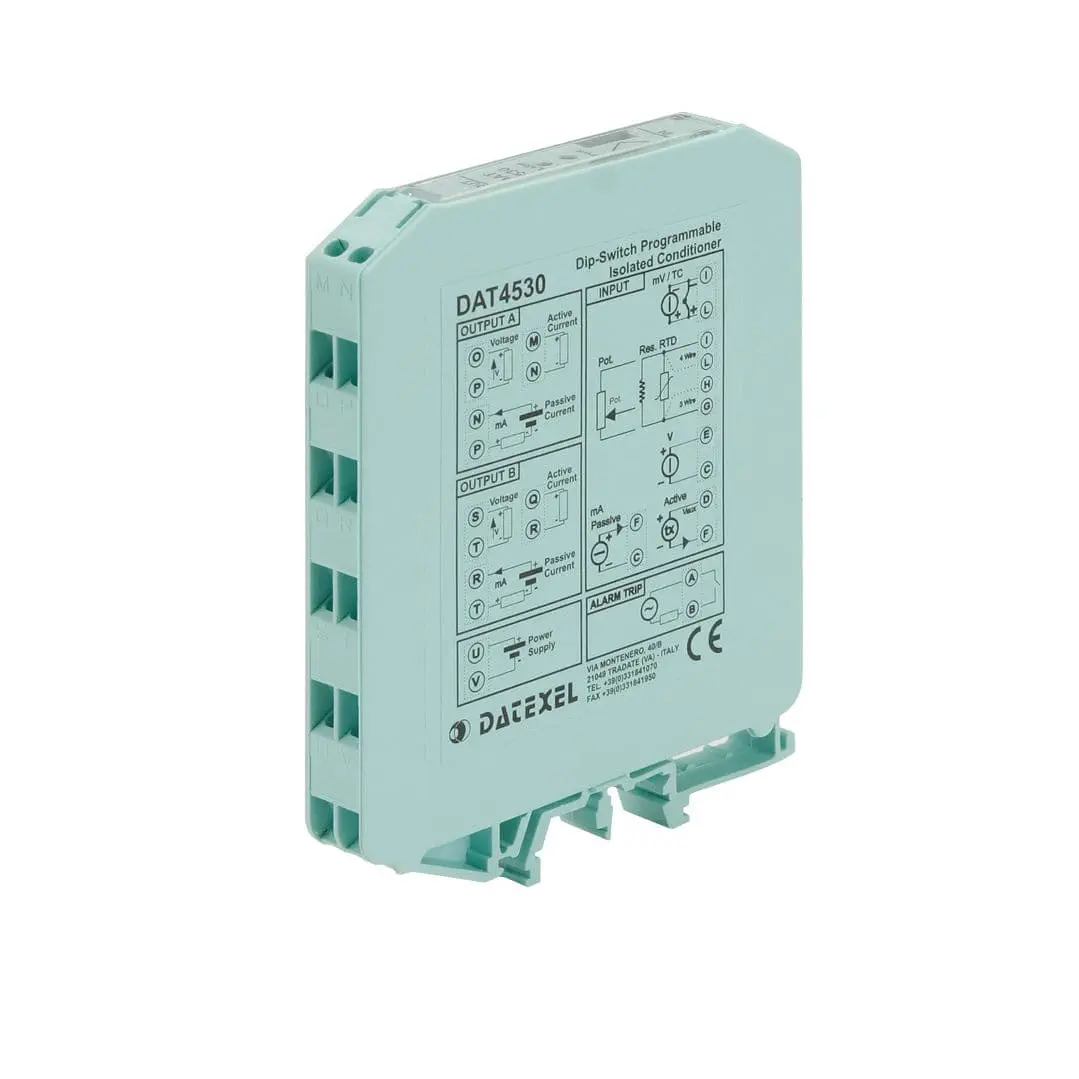
The DAT4530 signal splitter by Datexel is a universal industrial signal splitter and isolator designed to accept a wide range of input signals (4–20 mA, voltage, thermocouples, RTDs, resistance, potentiometers, and millivolt signals) and convert them into two fully isolated analog outputs. Each output can be independently configured for voltage or current, allowing one process measurement to be distributed to multiple control and monitoring systems simultaneously. The unit provides 3-way galvanic isolation between the input, outputs, and power supply to eliminate ground loops and reduce electrical noise, making it suitable for demanding industrial environments.
4. Resources
- [1] MinMax Power — Isolated vs Non-Isolated DC-DC Converters — minmaxpower.com
- [2] Datexel — Signal Splitters — datexel.com
- [3] Levtech — Isolated Splitter for Analog Signals — levtech.ro
- [4] Amazon — Kuuleyn Splitter/Conditioner/Isolator — amazon.com
Further information
Analog Outputs
- Analog signals setup with the RCP — how to edit the SME's analog output parameters in the Rheonics Control Panel.
- Connecting 4-20 mA outputs — wiring guidance for the SME's 4-wire transmitter analog outputs.
- Support Articles on Analog Outputs — full collection of articles covering the SME's analog signal features.